
Executive Summary
For commercial greenhouse operations, lighting is not a supporting system—it is a core production input that directly determines yield, crop quality, and return on investment. As a rule of thumb used by professional growers, a 1% increase in usable light typically delivers a 1% increase in harvestable yield for high-value crops such as tomatoes, cucumbers, peppers, cannabis, and ornamentals.
Modern greenhouse lighting has shifted from simple supplemental illumination to integrated light management, where artificial lighting, solar radiation, heating, cooling, and shading systems operate as one climate-control ecosystem.
This guide explains how to design, evaluate, and select commercial greenhouse lighting systems using plant-science metrics (PPFD and DLI), compares LED and HPS technologies from a B2B ROI perspective, and outlines how lighting must integrate with overall greenhouse climate control systems.
The Physics of Greenhouse Lighting: Beyond Lumens
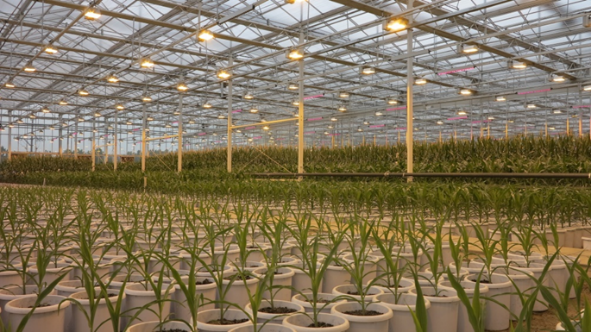
One of the most common mistakes in greenhouse lighting design is relying on human-centric metrics such as lumens or lux. Plants respond to photons, not brightness. Professional greenhouse lighting systems are therefore engineered around plant-specific measurements.
PAR (Photosynthetically Active Radiation)
PAR defines the wavelength range (400–700 nm) used for photosynthesis. It identifies which light wavelengths are useful, but it does not describe intensity or total light delivered.
PPFD (Photosynthetic Photon Flux Density)

The PPFD map above illustrates how fixture spacing and mounting height affect light uniformity across the crop canopy. In commercial greenhouse lighting systems, maintaining PPFD variation within ±15% is critical to ensure consistent growth and synchronized harvest cycles.
PPFD measures the number of PAR photons reaching the crop canopy per second (μmol/m²/s). It represents instantaneous light intensity. In commercial facilities, PPFD uniformity is critical; variations greater than 15% across the canopy often lead to uneven growth and harvest scheduling challenges.
DLI (Daily Light Integral)
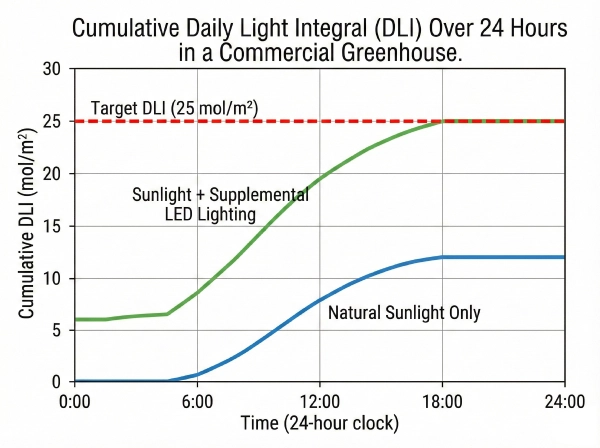
DLI curve showing natural sunlight and supplemental greenhouse lighting
DLI measures the total amount of usable light received per day (mol/m²/day). From an ROI perspective, DLI is the most important metric.
For example, a tomato crop typically requires 22–30 mol/m²/day for optimal productivity. If natural winter sunlight provides only 10 mol/m²/day, the greenhouse lighting system must supply the remaining 12–20 mol/m²/day through supplemental lighting.
How to Design a Commercial Greenhouse Lighting System (Step-by-Step)
A high-performing greenhouse lighting system is engineered, not selected from a catalog. Below is a simplified design framework used in professional projects.
Step 1: Define Crop Light Requirements
Different crops require different target DLI and PPFD levels. High-wire vegetables, flowering ornamentals, and propagation crops all respond differently to intensity and photoperiod.
Step 2: Assess Natural Light Availability
Key variables include geographic latitude, seasonal solar radiation, greenhouse orientation, and glazing material. Light transmission losses from aging coverings must also be accounted for.
Step 3: Select Lighting Technology
Choose between LED, HPS, or hybrid systems based on energy costs, climate conditions, and production goals.
Step 4: Design Fixture Layout and Spacing
Fixture spacing must deliver uniform PPFD across the crop canopy while minimizing shadowing during daylight hours.
Step 5: Integrate with Climate Control Systems
Lighting adds heat and drives transpiration. Coordination with commercial greenhouse heating systems, greenhouse cooling and ventilation systems, greenhouse shading systems is essential for stable temperature, humidity, and VPD control.
Step 6: Implement Controls and Automation
Modern commercial greenhouses use sensors and climate computers to dynamically adjust lighting output based on real-time DLI targets and solar input.
LED vs. HPS Greenhouse Lighting: A Commercial ROI Comparison
The decision between LED and High-Pressure Sodium (HPS) lighting is now primarily economic and operational rather than technical.
Metric | HPS Lighting | LED Greenhouse Lighting |
Efficacy (μmol/J) | 1.7–1.9 | 3.0–3.8+ |
Spectrum Control | Fixed | Fully tunable |
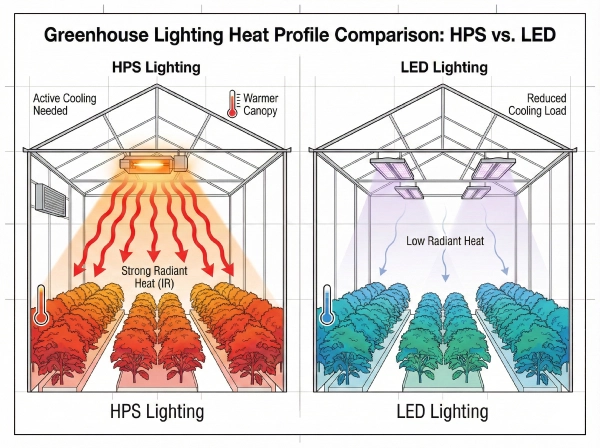
Radiant Heat | High | Low |
Fixture Lifespan (L90) | 10,000–15,000 hrs | 50,000–100,000 hrs |
Operating Cost | High | Low (40%+ savings) |
When HPS Still Makes Sense
In very cold climates, HPS fixtures can contribute meaningful radiant heat during winter, partially offsetting heating demand. However, rising electricity costs and frequent bulb replacement increasingly reduce long-term competitiveness.
Why LEDs Are Becoming the Standard
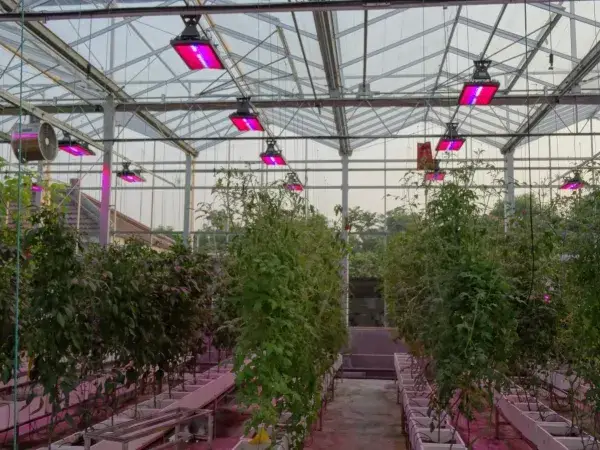
LED greenhouse lighting systems offer higher energy efficiency, spectrum customization, lower maintenance, and precise environmental control. Their low radiant heat output allows fixtures to be placed closer to crops and supports multi-layer or low-gutter greenhouse designs.
How to Choose the Right Greenhouse Lighting System
From a professional manufacturer perspective, the “best” greenhouse lighting system depends on project-specific variables.
Considerations include:
Greenhouse size and structure
Crop type and production cycle
Local electricity pricing and utility incentives
Climate zone (cold vs warm regions)
Integration with heating, cooling, and shading systems
A lighting solution optimized for a northern winter tomato facility will differ significantly from one designed for a southern ornamental operation.
Light Deprivation and Photoperiod Control
Lighting management is not only about intensity—it also involves photoperiod control.
A light deprivation greenhouse uses automated blackout screens to regulate day length. This is essential for short-day crops such as cannabis, chrysanthemums, and poinsettias, enabling year-round flowering regardless of natural daylight conditions.
In many regions, blackout systems also help meet light pollution regulations, which increasingly require nighttime containment of artificial greenhouse lighting.
Glazing, Light Transmission, and Supplemental Lighting
Greenhouse coverings directly affect lighting requirements.
Standard 6 mil polyethylene typically transmits 88–91% of light when new, but transmission can drop below 80% after several years due to UV degradation and contamination. This reduction directly impacts DLI and yield potential, increasing reliance on supplemental lighting during low-light periods.
Diffused glazing materials further improve canopy penetration, enhancing lower-leaf photosynthesis and overall crop uniformity.
Integrating Lighting with Greenhouse Climate Control
This lighting systems funtions as one subsystem within a broader integrated commercial greenhouse climate control systems strategy.
High-intensity greenhouse lighting systems significantly influence internal climate conditions.
Heat Load: HPS and high-output LED fixtures add measurable thermal energy.
Humidity: Increased transpiration raises humidity levels, requiring active ventilation or dehumidification.
VPD Management: Stable leaf temperature and humidity are critical for maximizing photosynthesis and nutrient uptake.
Structural Shadowing: Slim-profile fixtures reduce daylight shading when lights are off.
For this reason, lighting design should never be isolated from overall greenhouse climate control planning.
Cost, Rebates, and Payback Period
While LED greenhouse lighting systems require higher upfront investment, financial incentives often change the equation.
Utility rebate programs in North America and Europe frequently cover 25–50% of fixture costs, reducing payback periods to less than three years in many commercial projects.
Professional buyers increasingly evaluate systems using cost per mole of light, combining:
Amortized fixture cost
Electricity consumption
Maintenance and replacement costs
This metric provides a more accurate comparison than fixture price alone.
Why Choose Our Commercial Greenhouse Solutions
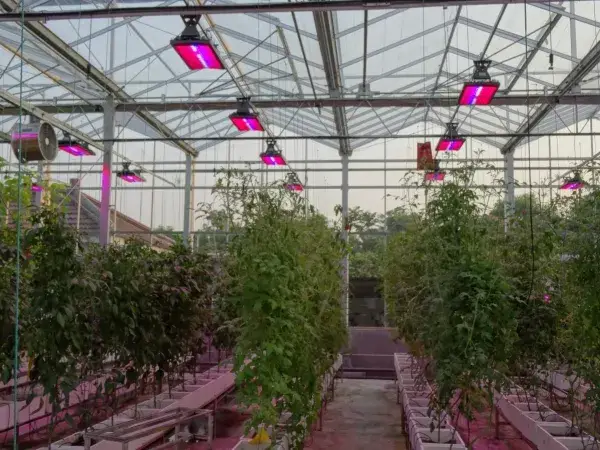
As a professional greenhouse manufacturer-Yixinhe greenhouse, we design lighting systems as part of a fully integrated climate control solution—not as isolated components.
Our approach focuses on:
System-level engineering: Lighting, heating, cooling, and shading are designed together to maintain stable DLI, temperature, humidity, and VPD.
Commercial scalability: Solutions engineered for multi-hectare glass and poly greenhouses, not hobby-scale installations.
ROI-driven design: Fixture selection, layout, and controls optimized for lowest cost per mole of light.
Future-ready infrastructure: LED-compatible electrical design, automation-ready controls, and upgrade flexibility.
For investors, growers, and EPC partners, this integrated approach reduces operational risk while maximizing long-term yield stability.
👉 Looking for a complete greenhouse or climate control solution?
Our engineering team supports growers, investors, and EPC partners with turnkey greenhouse structures and integrated systems. Contact us for greenhouse solutions to discuss your project requirements, production goals, and site conditions.
For investors, growers, and EPC partners, this integrated approach reduces operational risk while maximizing long-term yield stability.
Frequently Asked Questions About Commercial Greenhouse Lighting
Q1: How many hours per day should greenhouse lights be on?
A: Greenhouse lighting duration depends on crop-specific DLI targets and available sunlight. In winter, supplemental lighting may operate 12–18 hours per day to reach required DLI levels.
Q2: Is LED or HPS better for commercial greenhouses?
A: LED lighting is generally preferred due to higher efficiency, longer lifespan, and spectrum control. HPS may still be used in cold climates where radiant heat offsets heating demand.
Q3: How much does a commercial greenhouse lighting system cost?
A: Costs vary by greenhouse size, crop type, and lighting technology. LED systems require higher upfront investment but often achieve payback within 2–4 years due to energy savings and rebates.
Q4: Can greenhouse lights replace sunlight?
A: Artificial lighting supplements natural sunlight but does not fully replace it in most commercial greenhouses. The goal is to achieve target DLI consistently throughout the year.
Q5: What is the ideal PPFD for commercial crops?
A: Typical PPFD targets range from 150–300 μmol/m²/s for ornamentals and propagation to 250–400+ μmol/m²/s for high-wire vegetable crops.
Conclusion
A commercial greenhouse lighting system is a long-term investment that directly shapes yield stability, energy efficiency, and operational profitability. The most successful projects treat lighting as an integrated component of a comprehensive climate control strategy.
Before finalizing any lighting plan, greenhouse operators should evaluate structural light transmission, climate systems, and automation capabilities to ensure every photon delivers measurable value.
 English
 Malaysia
 Indonesia