
Executive Overview: What Is Greenhouse Climate Control?
Commercial greenhouse climate control refers to the integrated management of temperature, humidity, light, and air movement to create a stable, crop-optimized growing environment at scale.
Unlike hobby greenhouses that rely on manual ventilation or standalone heaters, commercial operations depend on coordinated systems—heating, cooling, shading, lighting, and automation—working together as one ecosystem. The objective is not simply plant survival, but predictable yield, consistent quality, disease prevention, and long-term energy efficiency.
For professional growers, investors, and EPC contractors, climate control is the single most important factor influencing:
Annual yield per square meter
Crop uniformity and market quality
Energy consumption (OpEx)
Capital return on greenhouse infrastructure
This page serves as the central pillar guide for understanding how modern greenhouse climate control systems function together and how each subsystem contributes to overall performance.
Greenhouse Climate Control Systems Overview (4 Core Systems)
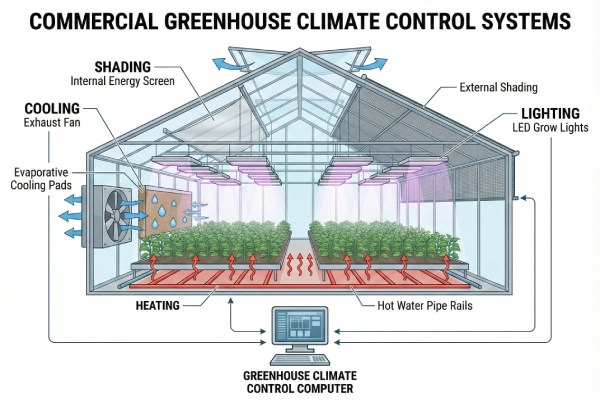
All climate systems are coordinated by the climate computer to maintain optimal Vapor Pressure Deficit (VPD) across varying conditions.
Commercial greenhouse climate control is built on four interconnected systems. Each system addresses a specific environmental challenge, but maximum performance is achieved only when they are engineered and operated as a unified whole.
System | Primary Function | Operational Impact | Learn More |
Heating Systems | Maintain night & winter temperature stability | Largest OpEx driver | Commercial Greenhouse Heating Systems |
Cooling Systems | Remove excess solar heat load | Prevent heat stress & crop loss | Commercial Greenhouse Cooling Systems |
Shading Systems | Reduce radiation & energy demand | Highest ROI investment | Greenhouse Shading Systems |
Lighting Systems | Increase DLI & production consistency | Yield multiplier | Commercial Greenhouse Lighting Systems |
Rather than optimizing these systems independently, modern greenhouse design focuses on system integration, where decisions in one pillar directly influence the others.
Why Temperature & Humidity Alone Are Not Enough: Understanding VPD
Traditional greenhouse management relied heavily on temperature setpoints. However, plants do not respond to temperature or humidity in isolation. They respond to the moisture gradient between the leaf and the surrounding air, defined as Vapor Pressure Deficit (VPD).

VPD is the most critical metric in professional greenhouse climate control because it directly governs:
Transpiration rate
Nutrient uptake efficiency
Stomatal behavior and CO₂ absorption
Disease pressure and condensation risk
When VPD remains within the optimal range—typically 0.8–1.2 kPa for most commercial crops:
Stomata remain open, supporting photosynthesis
Water and nutrients are transported efficiently
Leaf temperature remains biologically stable
If VPD is too low (excess humidity), transpiration slows and fungal diseases increase. If VPD is too high (dry air), plants close stomata to conserve water, halting growth. Effective climate control strategies therefore manipulate heating, ventilation, cooling, and shading together to maintain VPD within this “biological sweet spot.”
Pillar 1: Heating Systems — The Energy Foundation
Heating systems form the metabolic backbone of commercial greenhouse climate control, particularly for nighttime stability and winter production.
Large-scale greenhouses primarily rely on hydronic (hot water) heating systems, circulating thermal energy through steel pipe rails installed along crop rows, under benches, or within floors. This approach delivers uniform radiant heat while supporting vertical temperature stratification—warm roots with cooler air above the canopy.
Key heating strategies include:
Pipe rail heating for crop-level temperature stability
Root-zone heating to maintain plant metabolism while reducing ambient air temperature
Thermal buffering to store and redistribute heat efficiently
Integration with energy screens to minimize nighttime heat loss
Because heating represents the largest share of greenhouse OpEx in cold climates, proper system design has a direct and measurable impact on long-term profitability.
👉 Learn more about boiler selection, pipe layouts, and heating ROI in our guide to commercial greenhouse heating systems.
Pillar 2: Cooling Systems — Managing the Solar Heat Load
During peak solar radiation, a greenhouse behaves like a large solar collector. Without effective cooling, internal temperatures can exceed crop tolerance within minutes.
Greenhouse cooling systems are designed to remove excess heat while maintaining acceptable humidity and VPD levels. The optimal solution depends heavily on local climate conditions.
Common cooling strategies include:
Pad-and-fan evaporative cooling, effective in arid regions
High-pressure fogging systems, suitable for warm and humid climates
Natural and mechanical ventilation, using roof vents and exhaust fans
Horizontal Air Flow (HAF) fans, ensuring temperature uniformity
Cooling systems must be carefully synchronized with ventilation and shading. For example, operating cooling pads while roof vents are open can compromise system efficiency and increase energy waste—highlighting the importance of integrated control.
👉 Explore climate-specific cooling strategies in our detailed guide to commercial greenhouse cooling systems.
Pillar 3: Shading & Energy Screens — Passive Climate Control with the Highest ROI
Among all climate control investments, shading systems often deliver the fastest and most reliable return on investment.
By reducing incoming solar radiation, shading systems lower internal temperatures, decrease cooling demand, and stabilize light levels at the crop canopy.
Two primary approaches are used:
External shading, which blocks radiation before it enters the structure
Internal shading and energy screens, offering flexibility and automation
Modern internal energy screens serve a dual function:
Daytime: Reflect excess infrared radiation to reduce heat load
Nighttime: Act as thermal insulation, trapping heat near the crop
Well-designed energy screen systems can reduce heating energy consumption by 30–50%, making them a cornerstone of energy-efficient greenhouse design.
👉 Compare external shading and internal energy curtains in our guide to greenhouse shading systems.
Pillar 4: Supplemental Lighting — The Yield Engine
While heating and cooling create a survivable environment, light drives productivity.
Commercial greenhouse lighting strategies are built around Daily Light Integral (DLI)—a standard metric used in greenhouse crop production to quantify total usable light, commonly referenced in extension research from institutions such as Michigan State University Extension.
The industry is rapidly transitioning from HPS to LED greenhouse lighting, driven by advantages such as:
Higher energy efficiency
Spectrum tuning for crop morphology control
Minimal radiant heat emission
Compatibility with summer production
LED systems allow growers to manipulate plant behavior—reducing internode stretch, accelerating flowering, or increasing biomass—without overloading cooling systems.
Uniform PPFD distribution and proper light integration with shading and heating are essential to prevent microclimates and yield inconsistency.
👉 Learn about PAR mapping, LED ROI, and lighting strategies in our guide to commercial greenhouse lighting systems.
Greenhouse Automation & System Integration: The Climate “Brain”
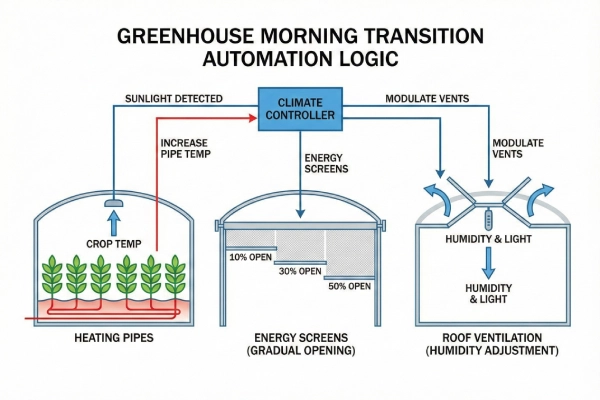
High-performance climate hardware is only effective when coordinated by a centralized control system. Greenhouse automation platforms, often referred to as climate computers, synchronize responses across all four pillars.
One of the most critical automation scenarios is the morning transition:
Heating pipes pre-warm the crop before sunrise
Energy screens open gradually to release humidity
Ventilation responds incrementally to solar gain
This sequence prevents condensation, fungal outbreaks, and plant stress—outcomes that manual control cannot reliably avoid.
Advanced systems increasingly use predictive weather data, enabling pre-emptive shading, cooling, or heating adjustments that improve environmental stability while reducing energy consumption.
Climate Control Strategy by Crop Type
Different crops impose fundamentally different climate requirements. Successful greenhouse climate control strategies are therefore crop-driven, not equipment-driven.
High-wire crops (tomato, pepper, cucumber)
Focus on vertical temperature uniformity and consistent DLILeafy greens & herbs
Require precise humidity control, strong air movement, and efficient coolingMedical cannabis & specialty flowers
Demand strict photoperiod control, dehumidification, and light deprivation
Designing systems around crop physiology ensures predictable production outcomes and higher ROI.
Energy Efficiency, Operating Cost & ROI Optimization
In 2025, commercial greenhouse climate control is increasingly evaluated through the lens of energy efficiency and long-term operating cost control.
High-impact optimization strategies include:
Automated energy screens to reduce heat loss
Heat recovery dehumidification systems
Thermal buffering and load balancing
Smart glazing and diffused light transmission
The most profitable greenhouses treat climate control as an integrated energy system, rather than a collection of standalone machines.
FAQ: Commercial Greenhouse Climate Control
What is the ideal VPD for commercial greenhouses?
For most crops, the optimal VPD range is 0.8–1.2 kPa, depending on growth stage and species.
Which climate control system has the highest ROI?
Energy screens and shading systems typically deliver the fastest ROI due to reduced heating and cooling demand.
Can one controller manage all greenhouse systems?
Yes. Modern climate computers integrate heating, cooling, shading, lighting, and ventilation into a single control platform.
Is greenhouse climate control expensive to operate?
Operating cost depends on climate, crop, and system integration. Well-designed systems significantly reduce long-term OpEx.
Design a Climate-Controlled Greenhouse That Performs
Effective commercial greenhouse climate control is not a collection of isolated components—it is a balanced, data-driven ecosystem.
By engineering heating, cooling, shading, and lighting as one unified system—guided by VPD and automation—you move from reactive farming to predictable, profitable production.
Ready to engineer your environment?
Our team provides heat load calculations, climate strategy design, and automation integration for commercial greenhouse projects worldwide.
 English
 Malaysia
 Indonesia