
Key Takeaways
Cooling is Crop Survival: Internal temperatures above 30°C can halt growth; above 35°C can cause fruit abortion.
Humidity Dictates Strategy: "Pad and Fan" systems are powerful in dry climates but fail in humid tropical regions.
Passive vs. Active: Always maximize passive ventilation (e.g., Sawtooth roof) before investing in active cooling machinery.
Physics Limit: You cannot cool air below its "Wet Bulb" temperature. Understanding this physics rule prevents costly design errors.
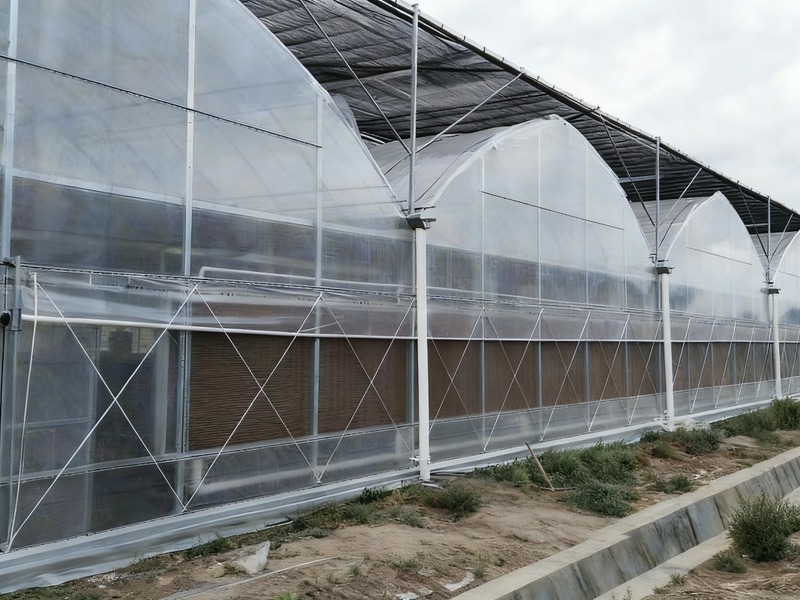
commercial greenhouse with cooling pad
In commercial horticulture, heat is a silent yield killer.
While cold weather simply slows down plants, extreme heat can cause irreversible damage. When internal greenhouse temperatures exceed 30°C (86°F), photosynthesis in crops like tomatoes slows down. Exceed 35°C (95°F), and you risk flower abortion and total crop loss.
However, designing a cooling system for your commercial greenhouse is far more complex than heating.
Heating works the same way in Russia as it does in Canada. But cooling? A strategy that works perfectly in the dry deserts of Arizona will fail miserably in the humid tropics of Thailand.
To protect your investment, you must choose a system based on your local Physics of Evaporation.
Cooling is just one part of the equation. This guide is part of our complete Commercial Greenhouse Climate Control Series.
The Physics of Cooling: Understanding the "Wet Bulb" Limit
Before you buy a single fan, you must understand one concept: Wet Bulb Depression.
Most active greenhouse cooling systems (Pad & Fan, Fogging) rely on Evaporative Cooling. Water evaporates, absorbing heat energy from the air, thus lowering the temperature.
However, air can only absorb a certain amount of water. Once the humidity reaches 100% (saturation), evaporation stops, and cooling stops.
The Golden Rule: You can only cool the air down to its "Wet Bulb" temperature.
In a Dry Climate (30% RH): The air is thirsty. You can easily drop the temperature by 10-15°C.
In a Humid Climate (80% RH): The air is saturated. You might struggle to drop the temperature by even 2°C.
The Takeaway: Do not install evaporative cooling pads in a high-humidity region. They will just make your greenhouse hot and soggy.
Strategy 1: Natural Ventilation – The Passive Foundation
The most cost-effective greenhouse cooling system is free: Airflow.
Natural ventilation relies on the "Chimney Effect" (Thermal Buoyancy). Hot air rises and escapes through roof vents, creating a vacuum that pulls cooler air in from the sides.
Structure Matters
Standard tunnel greenhouses often trap heat at the peak. For tropical regions, you need a structure engineered for airflow.
This is where the Sawtooth Greenhouse excels. Its vertical roof vents remain permanently open (or automated), allowing continuous heat escape even during rain.
👉 ROI Tip:
Operating in a tropical climate? Running fans 24/7 is an OpEx nightmare. See why the Sawtooth Type Greenhouse is the ROI king for natural ventilation.
Strategy 2: Pad and Fan System (Negative Pressure)
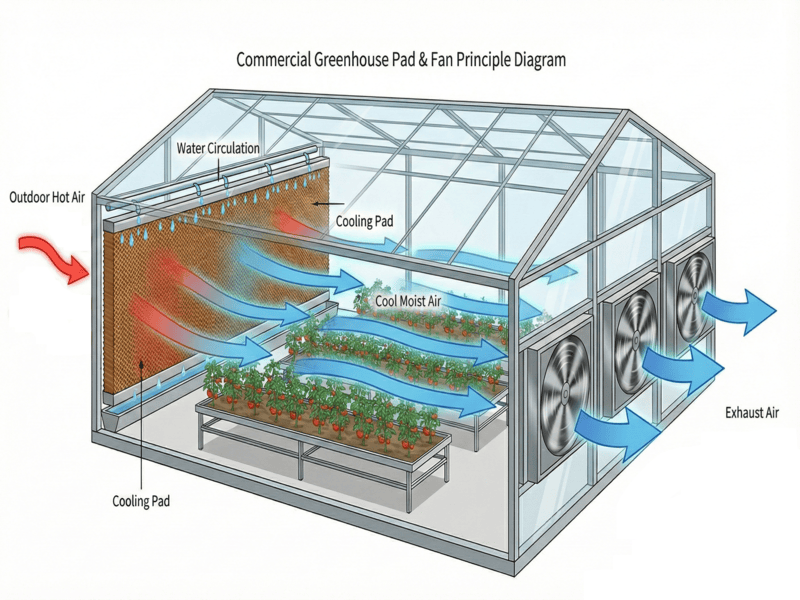
For hot and DRY climates (e.g., Middle East, North Africa, US Southwest), the "Pad and Fan" system is the standard solution.
How it Works
Exhaust: Massive fans on one end wall pump air out, creating negative pressure inside the greenhouse.
Intake: Air is sucked in through the opposite wall, which is covered with wet cellulose pads.
Cooling: As air passes through the wet pads, water evaporates instantly, chilling the air stream.
B2B Pro Tip: To ensure temperature uniformity in commercial greenhouse cooling systems, the distance from pad to fan should ideally not exceed 40-50 meters. Longer distances result in a temperature gradient—one end of the crop is cool, the other is hot.
Building in an arid region? Get a quote for our Pad & Fan Systems.
Strategy 3: High-Pressure Fogging (Positive Pressure)
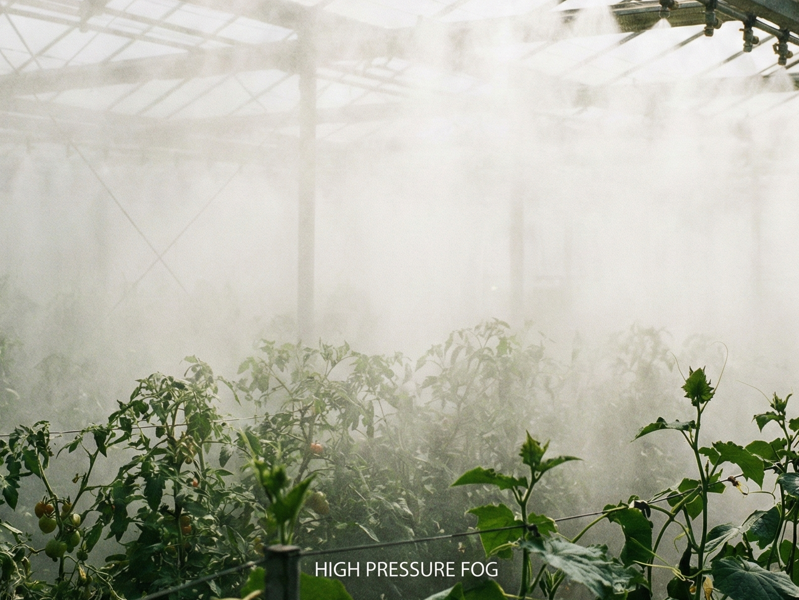
For growers who need better uniformity or humidity control, High-Pressure Fogging is the premium choice among commercial greenhouse cooling systems.
Difference from "Misting"
This is critical. "Misting" systems operate at low pressure and create large droplets that fall on leaves, causing disease (Botrytis).
High-Pressure Fogging operates at 1000+ PSI (70 Bar). It creates billions of micron-sized droplets (10-20 microns) that "flash evaporate" instantly in the air.
Uniformity: Nozzles are distributed throughout the entire greenhouse, eliminating the hot/cold gradient of Pad & Fan systems.
Humidification: It can be used to manage VPD (Vapor Pressure Deficit) even when maximum cooling isn't the primary goal.
The First Line of Defense: Shading Systems
It is always cheaper to block heat than to remove it.
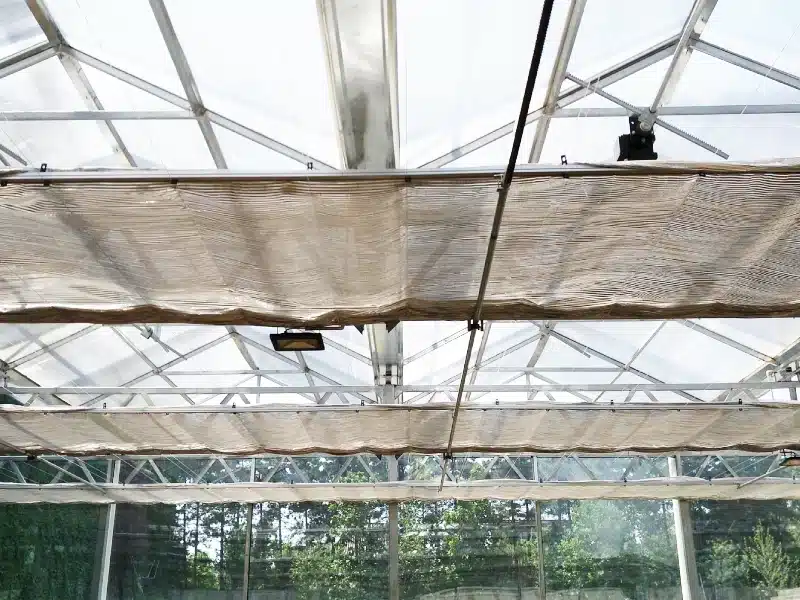
Solar Radiation is the source of your heat. By installing an Automated Shading System, you can block 50-70% of that energy before it heats up your air.
External Shading: The most effective cooling method. It blocks heat outside the glass/plastic.
Internal Shading: Blocks light but traps some heat inside. Often used with aluminized screens that reflect infrared radiation.
Decision Matrix: Selecting for Your Climate
Which greenhouse cooling system should you invest in?
Scenario / Climate | Recommended Strategy | Why? |
A: Hot & Dry | Pad & Fan System | Low humidity allows for max evaporative efficiency (up to 15°C drop). |
B: Hot & Humid | Sawtooth Roof + External Shade | Evaporation won't work well. You must rely on max airflow and blocking sun. |
C: Temperate Summer | Roof Vents + Fogging | Fogging provides cooling peaks and essential humidity control for VPD. |
Conclusion
Effective cooling requires a layered approach: Block the sun (Shade), Remove hot air (Ventilation), and Cool the remaining air (Evaporation).
Don't just buy fans; buy a climate strategy.
Selecting the right commercial greenhouse cooling system relies heavily on the greenhouse volume and glazing properties. If you haven't decided on your greenhouse structure yet, review your choices in in our Commercial Greenhouses 101 Guide.
Don't install the wrong system. Consult our engineers for a local climate analysis and cooling capacity calculation.
 English
 Malaysia
 Indonesia