
In modern agriculture, controlling the growing environment is key to success. Growers continually seek innovative methods to address climate challenges and maximize crop yield and quality. Among numerous greenhouse designs, one structure stands out for its distinctive shape and exceptional performance, particularly in hot climates—the sawtooth type greenhouse.
This greenhouse is not only visually striking, but its design embodies profound engineering wisdom. Drawing inspiration from architectural principles of the Industrial Revolution, it ingeniously adapts these concepts to modern agriculture, becoming the preferred solution for growers in tropical, subtropical, and arid regions.
This comprehensive guide delves into the sawtooth greenhouse, exploring its operational principles, design evolution, advantages and disadvantages, and comparing it with other popular greenhouse structures. Whether you're an experienced commercial grower or an investor planning to enter the field of protected agriculture, this article provides all the information you need to make informed decisions.
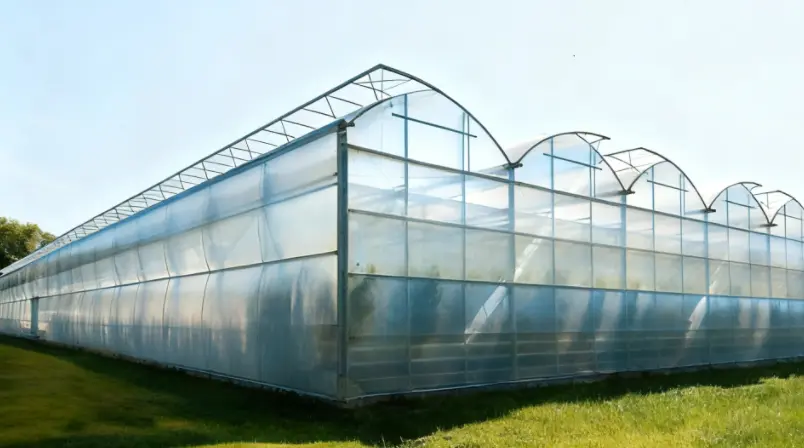
What exactly is a sawtooth type greenhouse?
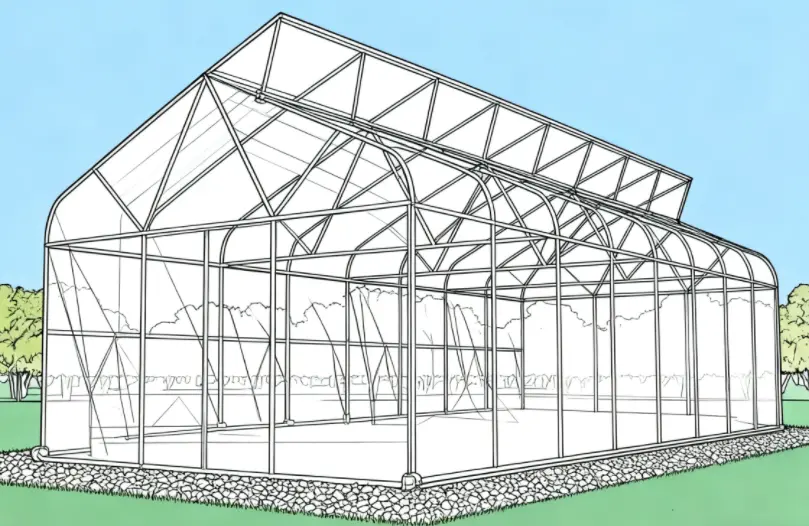
As the name suggests, the most distinctive feature of a sawtooth greenhouse is its unique sawtooth roof profile. This design consists of a series of interconnected arches, each roof featuring alternating high and low sections that form a continuous zigzag pattern. The design's crowning touch lies in the placement of a vertical or near-vertical ventilation window at the apex of each “tooth,” which is crucial for the structure to fulfill its core function.
Interestingly, this design did not originate in agriculture. Its prototype can be traced back to 19th-century industrial architecture. Factories of that era required a method to provide ample, uniform natural light to vast workshops while efficiently expelling the substantial heat and fumes generated by machinery. The sawtooth roof and its vertical windows offered an elegant, passive solution before the advent of electric lighting and mechanical ventilation systems. Applying this proven technology to greenhouses means its core functions—natural ventilation and climate control—have stood the test of time.
Today, serrated greenhouses are typically constructed in multi-span configurations with gutter connections to meet the demands of large-scale commercial agriculture. They are particularly suited for high-value crops requiring precise climate control, such as fruits, vegetables, and flowers.
Working Principle: Harnessing the Natural Force of the “Chimney Effect”
The exceptional performance of the Sawtooth Greenhouse centers on a simple physical principle—the “chimney effect”, also known as thermal pressure ventilation. This mechanism utilizes the power of natural convection to create a continuous air exchange cycle within the greenhouse, thereby regulating the internal microclimate with minimal energy consumption.
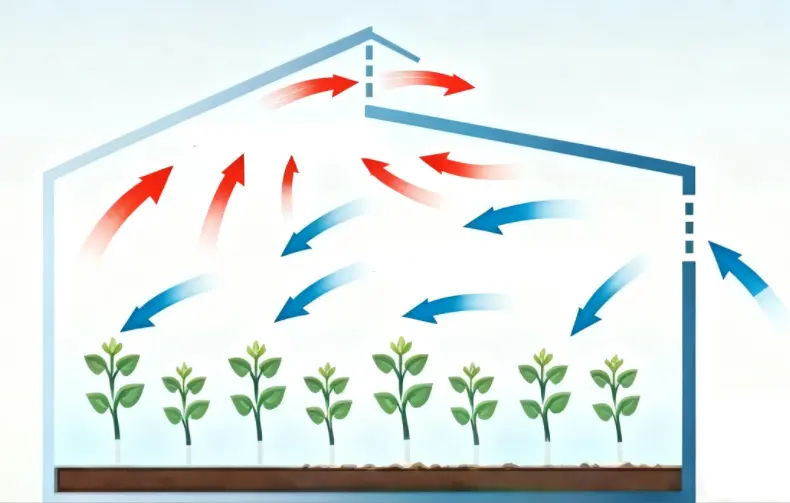
The process unfolds as follows:
Heating and Rising: Sunlight penetrates the greenhouse covering, heating the internal air, plants, and soil. As the internal air warms, its density decreases and it becomes lighter, naturally rising toward the greenhouse roof.
Exhausting Warm Air: Vertical vents positioned at the highest point of each roof provide an ideal exit for this warm, humid air.
Intake of Cool Air: As warm air is expelled from the top, a slight negative pressure forms inside the greenhouse. This pressure differential draws cooler, denser external air into the structure through lower intake vents, typically located in the side walls.
Continuous Circulation: This process creates a self-sustaining airflow cycle that efficiently removes excess heat and humidity, establishing a cooler, more comfortable growing environment for crops.
Growers typically control this process through roll-film systems installed on vertical vents, which can be operated manually or automatically to adjust ventilation as needed. This clever utilization of natural forces significantly reduces reliance on energy-intensive fans and cooling systems, forming the basis of its economic and environmental advantages.
Design Evolution: Three Core Types of Sawtooth Greenhouses
With advancements in engineering technology, sawtooth greenhouses have evolved into several distinct designs to accommodate more diverse climatic conditions and structural requirements.
1. Triangular Sawtooth Greenhouse
This represents the earliest and simplest design. Its roof consists of a series of sharp triangular sections. This clean geometric shape facilitates excellent air circulation and rainwater drainage, making it suitable for regions with moderate rainfall. The steeply pitched roof also minimizes structural shading, ensuring crops receive uniform light exposure.

2. Single Half-Arch Sawtooth Greenhouse
This represents a significant improvement over the triangular base, replacing one straight slope with an arched roof. This curved design substantially enhances the structure's load-bearing capacity, better distributing the pressure from rainwater and even snow accumulation, making the greenhouse more robust and durable. It strikes an excellent balance between cost-effectiveness and functionality, making it an ideal choice for small to medium-scale commercial cultivation.

3. Double Half-Arch Sawtooth Greenhouse
This represents the most advanced and robust variant currently available. It incorporates two arched roofs of differing lengths within each bay. This dual-arch design further optimizes ventilation while creating a more aerodynamically efficient profile that effectively reduces wind pressure, enabling it to withstand extreme weather conditions like high winds. Consequently, the double half-arch design is the preferred choice for large-scale commercial plantations and regions with harsh climates.
Significant Advantages of Sawtooth Greenhouses
Growers who choose sawtooth greenhouses typically value the powerful advantages their design delivers.
Exceptional Natural Ventilation This represents the sawtooth greenhouse's core advantage. Its elevated vertical vents create substantial ventilation area, maximizing the stack effect for highly efficient air exchange. Computational Fluid Dynamics (CFD) models indicate ventilation rates of 1.4 to 4.01 air changes per minute under ideal configurations—far exceeding standard requirements for effective cooling. Crucially, in tropical regions, these vertical vents remain operational even during torrential downpours, ensuring continuous ventilation and heat dissipation—a significant advantage unmatched by traditional roof-ventilated greenhouses.
Optimized Lighting Environment The sawtooth roof acts as an exceptional sunlight collector, with its angle and length customizable for different latitudes to ensure ample year-round illumination. Simultaneously, its vertical surfaces typically face away from direct sunlight paths. This not only reduces harsh glare that could scorch crop leaves but also promotes even distribution of diffused light. It eliminates “light spots” and shadowed areas, fostering more uniform and healthier crop growth.
Significant Energy Savings and Cost Reduction By relying on natural ventilation, serrated greenhouses drastically reduce the need for mechanical cooling systems, yielding substantial savings in electricity costs. This proves particularly valuable in regions with high electricity rates or unstable power supply. Furthermore, optimized natural light utilization reduces reliance on artificial supplemental lighting, further lowering operational expenses. Effective ventilation also aids in humidity control, minimizing fungal diseases caused by damp environments and consequently reducing pesticide costs.
Robust Structure and Disaster Resistance Modern sawtooth greenhouses, especially arched variants, typically feature hot-dip galvanized steel frames that offer structural integrity and exceptional corrosion resistance. Their design withstands wind loads up to 150 km/h, while sloped roofs rapidly drain rainwater, preventing structural stress from water accumulation
Potential Drawbacks and Considerations
While sawtooth greenhouses excel in hot climates, their specialized design introduces limitations, particularly in colder regions.
Poor Insulation in Cold Climates This is undoubtedly their greatest drawback. The large vents designed for ventilation and the complex roof surface area become major sources of heat loss during winter. Even when vents are closed, drafts can easily occur, leading to sharply increased heating costs. Consequently, sawtooth greenhouses are generally not recommended for temperate climates with cold winters unless costly insulation upgrades are implemented (such as installing double-layer inflatable membranes and internal insulation curtains).
Higher Initial Construction Costs Compared to simpler structures like Quonset arches or standard gable-roof greenhouses (Even-Span), the complex roof structure of sawtooth greenhouses requires more precise engineering and additional materials, resulting in higher initial construction costs. Investors should view this as a long-term investment, recouping upfront expenses through future operational cost savings.
Condensation Issues Some designs with flatter roof slopes may experience condensation dripping onto crops, increasing disease risk. However, modern greenhouse cover materials typically feature anti-drip coatings that significantly mitigate this problem.
Ideal Applications: Sawtooth Greenhouses' Prime Stage
The unique design of sawtooth greenhouses makes them irreplaceable in specific scenarios.

Ideal Climate Zones: They are widely recognized as the top choice for tropical, subtropical, and arid/desert regions. In these areas, managing high temperatures and humidity is a primary challenge for agricultural production, and the passive ventilation system of serrated greenhouses is the perfect tool to address this challenge.
Suitable Crops: Their stable, controllable environment is highly suitable for the commercial production of high-value crops, including:
Vegetable Cultivation: Tomatoes, cucumbers, bell peppers, leafy greens, etc.
Flower Production: Cut flowers and ornamental plants like roses requiring precise temperature and humidity control.
Seedling Nurseries: Providing a stable, protected growth environment for delicate seedlings.
Soilless Cultivation: Its spacious, unobstructed interior and robust truss structure make it an excellent platform for hydroponic and aquaponics systems.
Side-by-Side Comparison: Sawtooth Greenhouse vs. Other Mainstream Designs
To better understand its market positioning, let's compare it with two other common commercial greenhouse designs.
Sawtooth Greenhouse vs. A-Frame Greenhouse (Even-Span Greenhouse)
This represents a classic trade-off between ventilation and insulation.
Ventilation: The sawtooth greenhouse undoubtedly excels in natural ventilation efficiency, particularly its ability to maintain airflow during rainy seasons—a capability the A-frame greenhouse struggles to match.
Insulation: The A-frame greenhouse features a simpler structure with superior sealing, resulting in higher heating efficiency and lower operational costs in cold climates.
Cost: Typically, the construction cost of an A-frame greenhouse is lower than that of the more complex sawtooth greenhouse.
Sawtooth Greenhouse vs. Quonset/Hoop House
This is a comparison of performance versus investment.
Cost: Hoop houses represent the most economical greenhouse structure currently available. They are easy to construct and serve as an entry-level option for small-scale or seasonal production. Gable-roof greenhouses, however, require a higher capital investment.
Durability and Climate Control: The engineered steel structure of a gable-roof greenhouse is significantly sturdier than the bent-tube frame of a hoop house, offering superior resistance to severe weather. Regarding climate control, the hoop house is a precision tool designed for exact environmental management, while the Quonset/Hoop House provides only basic shelter with significant internal environmental fluctuations. One study showed that during summer, the interior of a hoop house was 6°C higher than the ambient temperature, whereas the Quonset/Hoop House was only 4°C higher, demonstrating its superior cooling performance.
Conclusion: Is a Sawtooth Type Greenhouse Right for Your Cultivation?
The sawtooth greenhouse is a highly specialized agricultural facility that maximizes passive natural ventilation efficiency through ingenious engineering. It represents a strategic trade-off: accepting higher initial investment in exchange for significantly reduced long-term operating costs in hot climates and a more stable, high-yield growing environment.
Final recommendations are as follows:
For commercial growers in tropical, subtropical, and arid regions: Highly recommended. It is the ideal choice for year-round high-value crop production. Its exceptional ventilation/cooling capacity and structural resilience will deliver a powerful competitive advantage and substantial return on investment.
For growers in temperate regions with cold winters: Proceed with caution. Unless your budget allows for comprehensive insulation upgrades (e.g., double-layer insulation film, internal insulation curtains), traditional gable-roof greenhouses may offer a more economical and energy-efficient alternative.
For small-scale, seasonal, or budget-constrained growers: Tunnel greenhouses provide a more suitable entry-level solution with their extremely low initial costs.
These recommendations make it clear that selecting your structure is the foundational first step. You now have a deep understanding of the specialized Sawtooth model. To place this knowledge into the context of your entire project, you can return to our Commercial Greenhouses 101 Buying Guide. There, you can see how this choice impacts your next steps, such as covering materials, systems, and overall project costs.
Our team of agricultural engineers specializes in designing custom greenhouse structures tailored to your specific location, crop requirements, and business goals. We'll help you analyze your needs and configure the optimal system—from frame and covering to fully integrated automation—to ensure you achieve maximum efficiency and profitability.
 English
 Malaysia
 Indonesia