
Key Takeaways:
The Cooling Rule: External shading is physically superior for cooling because it blocks radiation before it enters the greenhouse.
The Efficiency Rule: Internal shading doubles as an "Energy Curtain," saving up to 50% on winter heating bills (OpEx,operating costs).
Scale Matters: Small tunnels rely on coatings; large Venlo structures use precision rack & pinion drives.
ROI Verdict: Use External for tropical/desert climates where cooling is the #1 cost. Use Internal for temperate/cold climates where versatility matters most.
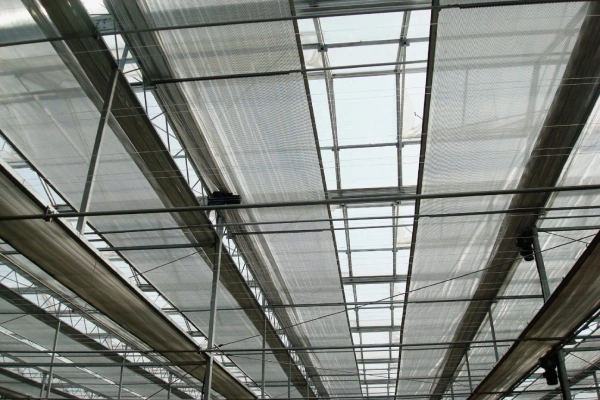
In commercial greenhouse design, climate control starts long before you turn on a fan or a heater.
It starts with managing the massive amount of energy hitting your roof: Solar Radiation.
Installing effective commercial greenhouse shading systems is often the most cost-effective way to lower temperatures. It is far cheaper to block heat (passive) than to remove it with electricity (active).
However, growers face a critical engineering choice: Should the shade system go Inside (Internal) or Outside (External)? And what drive system fits my scale?
This is not just a structural question; it is an ROI calculation based on your local climate's primary OpEx driver: Cooling vs. Heating.
This analysis is part of our Commercial Greenhouse Climate Control Series.
The Physics of Heat Rejection
To understand the difference between various commercial greenhouse shading systems, we must look at the energy flow.
External Shading: It intercepts short-wave solar radiation heat gain before it passes through the glass or plastic. The heat is dissipated into the outside air. Result: Maximum Cooling Efficiency.
Internal Shading: Solar radiation passes through the glazing, hits the internal screen, and is converted into heat. Some heat is reflected out, but some is trapped between the screen and the roof (the "heat trap"). Result: Moderate Cooling Efficiency.
Scaling Up: Shading Strategies by Facility Size
There is no "one size fits all." A berry tunnel needs a different ROI strategy than a 10-hectare tomato facility. Here is how shading technology evolves with scale.
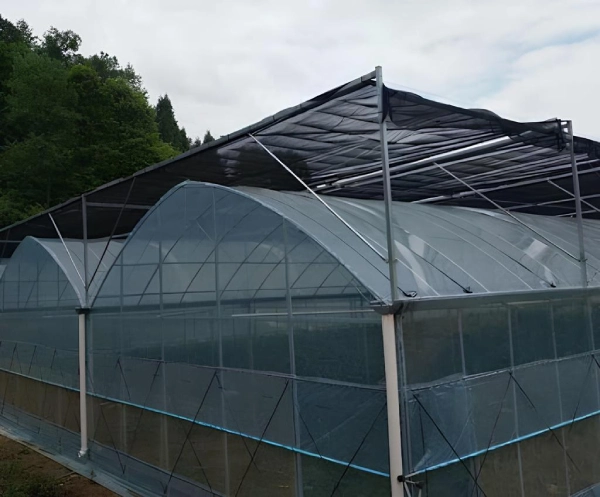
Level 1: Entry-Level & Seasonal (Tunnels / Quonset)
For standalone plastic tunnels or seasonal production, automated mechanical systems are often too heavy and expensive. The focus here is on simplicity and low maintenance.
Primary Solution: Shade Coatings (Whitewashing). A special paint applied to the exterior plastic.
Pro: Extremely cheap; follows the roof curve perfectly.
Con: Permanent for the season (can't "turn off" on cloudy days).Secondary Solution: Fixed External Nets. Simple knitted nets thrown over the tunnel structure.
Level 2: Mid-Tier Commercial (Multi-Span Poly / Gothic Greenhouse)
As you scale up to gutter-connected multi-span structures, automation becomes essential to manage labor costs. Precision requirements increase.
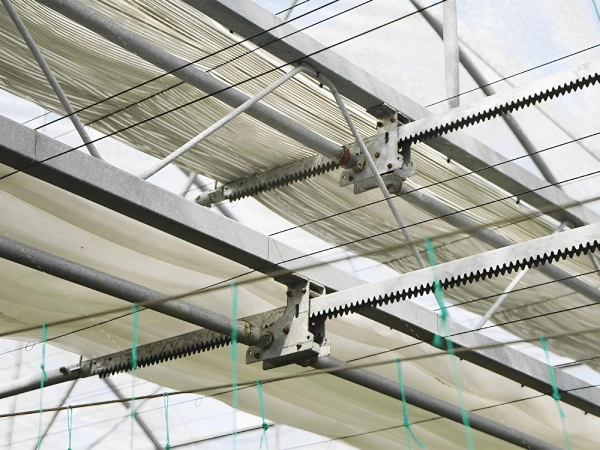
Primary Solution: Cable-Driven Internal Systems.
Mechanism: The screen fabric slides on stainless steel wires, pulled by a steel cable driven by a tubular motor.
Why: It is lighter and cheaper than rack & pinion, making it perfect for the lighter load-bearing capacity of poly greenhouses.Focus: Balancing moderate climate control with affordable installation costs.
Level 3: Large-Scale High-Tech (Venlo Glass Projects)
For modern glasshouses (>1 Hectare) growing high-value crops (Cannabis, Vine crops, Ornamentals), the shading system is a critical precision tool.
Primary Solution: Rack & Pinion (Push-Pull) Systems.
Mechanism: Steel push-rods driven by gear racks.
Why: Extremely robust and precise. It allows for "gapping" (opening exactly 2%) to release humidity without dumping cold air.Advanced Strategy: Multi-Screen Layers.
It is common to install 2 or 3 separate screens on different truss layers:
1. High Transmission Energy Screen (for winter nights).
2. High Reflection Shade Screen (for summer days).
3. Blackout Screen (for photoperiod control).
Planning a large-scale project? Discuss Multi-Layer Screen configurations with our engineers.
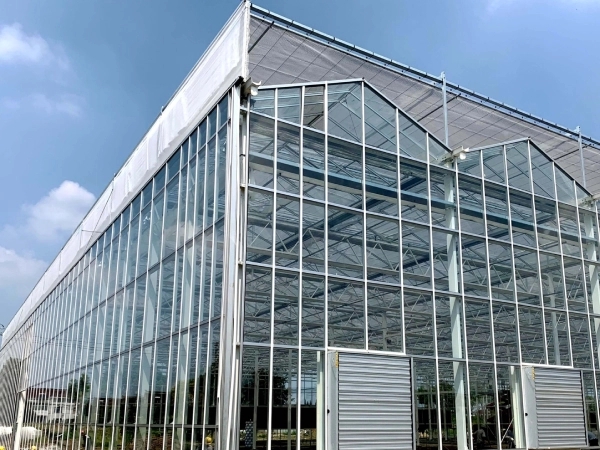
Greenhouse external shading net
Option 1: External Shading Systems (The Cooling Specialist)
Typically used in plastic tunnel ranges or low-tech structures, but increasingly seen in high-end glasshouses in extremely hot regions.
Pros (The ROI Drivers)
Superior Temperature Drop: Can lower internal temperatures by 5°C to 10°C more effectively than internal screens.
Reduced Cooling Load: Significantly reduces the electricity consumption of Pad & Fan systems.
Cons (The Risks)
Maintenance Nightmare: Exposed to UV, rain, and wind. The fabric degrades faster and mechanisms can jam.
Wind Vulnerability: In high winds, external systems must retract to avoid damage—exactly when you might need them.
Structure Conflict: Can interfere with roof vents (especially on Venlo structures).
Option 2: Internal Shading Systems (The Versatile Multitasker)
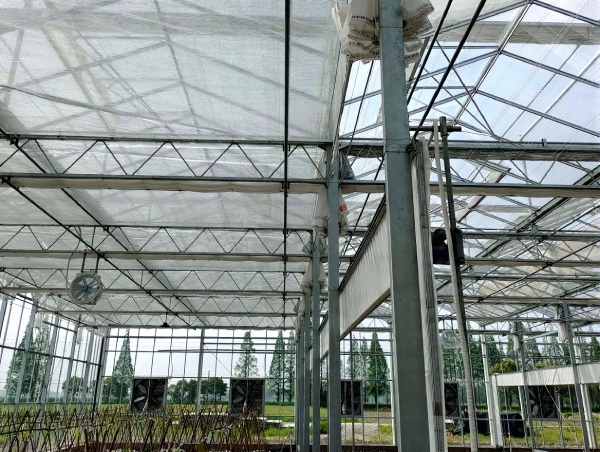
This is the standard for modern commercial greenhouse shading systems in Venlo Glass & High-End Poly structures. The screen runs horizontally on truss chords.
Pros (The ROI Drivers)
Dual Function (Energy Screen): This is the game-changer. At night, the screen closes to trap heat rising from the crop. Research by UMass Amherst indicates potential energy savings of up to 50% on heating costs.
Longevity: Protected from the elements, internal systems often last 8-12 years.
Light Diffusion: White or aluminized screens scatter light, penetrating deeper into the crop canopy.
Cons (The Risks)
Heat Trap: As mentioned, it is less effective at absolute cooling. You need good roof ventilation to let the trapped hot air escape.
Comparison Matrix: Commercial Greenhouse Shading Systems
Feature | External Shading | Internal Shading |
Cooling Efficiency | High (Blocks heat outside) | Medium (Traps some heat) |
Winter Insulation | None | High (Acts as Thermal Screen) |
Drive System | Cable / Roll-up | Cable / Rack & Pinion |
Lifespan | 3-5 Years (Weather exposed) | 8-12 Years (Protected) |
Initial Cost (CapEx) | Medium | Medium-High |
Best Climate | Tropical / Arid Desert | Temperate / Cold / Variable |
Advanced Material Tech: The Power of Aluminum
In modern internal systems, we rarely use simple black "shade cloth." We use Aluminized Screens (e.g., Svensson or similar).
Daytime: The aluminum strips reflect sunlight out of the greenhouse (improving cooling).
Nighttime: The aluminum strips reflect long-wave thermal radiation (heat) back down to the crop (improving heating).
Upgrade your efficiency. See our Aluminized Thermal Screen options.
Conclusion: Calculating Your ROI
Which system pays for itself faster?
Scenario A (Middle East / Tropical): Your biggest OpEx is electricity for cooling. External Shading yields the best ROI by aggressively reducing heat load.
Scenario B (Canada / Europe / North China): Your biggest OpEx is fuel for heating. Internal Shading is the clear winner because it saves massive amounts of energy at night while providing sufficient shading in summer.
Your Next Steps:
Analyze Your OpEx: Look at your utility bills. Is your pain point Summer Cooling or Winter Heating?
Review the Whole System: Return to the Climate Control Hub to see how shading integrates with heating and ventilation.
 English
 Malaysia
 Indonesia