
Yes, ventilation is the lifeline of any commercial greenhouse. It regulates internal temperature, manages humidity levels (VPD), and replenishes carbon dioxide (CO2). Without effective air exchange, commercial crops suffer from immediate heat stress and rapid fungal disease outbreaks.
However, a common misconception among growers is that "ventilation" equals "buying expensive exhaust fans."
In professional agricultural engineering, ventilation starts with the structure, not the equipment. For commercial operations—especially in tropical climates like Southeast Asia—relying solely on mechanical fans can destroy profit margins due to high electricity costs.
This guide explores the physics of airflow, compares the true costs of mechanical vs. natural ventilation, and helps you select the right greenhouse structure to cool your crops for free.
1. Temperature Control
Ventilation is the primary mechanism for removing excess sensible heat generated by solar radiation inside a greenhouse. As internal air temperature rises above ambient levels, hot air accumulates in the upper zones of the structure, particularly near the roof and gutter lines.
How and why this matters in practice:
In commercial greenhouses, especially multi-span structures, temperature stratification can easily exceed 5–8°C between crop level and roof level if ventilation is insufficient. This trapped heat not only stresses crops directly but also reduces the effectiveness of shading and evaporative cooling systems. Proper ventilation allows hot air to escape continuously, preventing heat buildup before it reaches crop-damaging thresholds, rather than attempting to correct overheating after it occurs.
2. Humidity and Vapor Pressure Deficit (VPD)
Plant transpiration constantly releases moisture into the greenhouse air, raising relative humidity levels throughout the day. Ventilation removes this moisture-laden air and replaces it with drier outside air, helping maintain a stable vapor pressure deficit suitable for plant growth.
How and why this matters in practice:
In dense commercial canopies, stagnant humid air pockets often form below gutter height and within the crop canopy itself. Without adequate air exchange, relative humidity can remain above 85–90% for extended periods, even when temperatures appear acceptable. This suppresses transpiration, disrupts nutrient uptake, and creates ideal conditions for fungal diseases such as Botrytis and powdery mildew. Ventilation restores a healthy VPD by continuously flushing out saturated air, which cannot be achieved reliably through circulation fans alone.
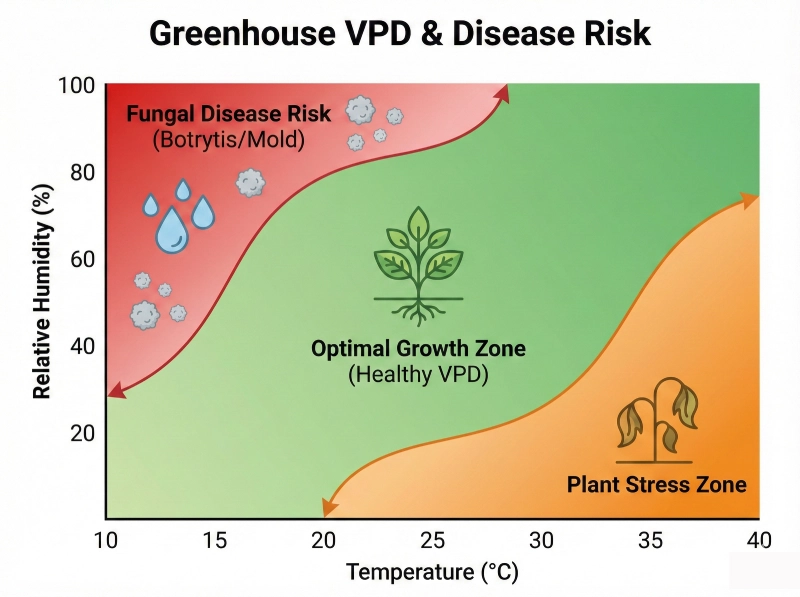
Maintaining crops within a healthy VPD range is critical to balancing transpiration, disease suppression, and overall crop performance.
3. Carbon Dioxide (CO₂) Replenishment
During daylight hours, crops rapidly consume carbon dioxide for photosynthesis, often reducing CO₂ concentrations well below ambient outdoor levels in enclosed greenhouses. Ventilation replenishes CO₂ by introducing fresh outside air into the growing environment.
How and why this matters in practice:
In tightly sealed commercial greenhouses, CO₂ depletion can occur within one to two hours after sunrise, significantly limiting photosynthetic efficiency even when light and temperature are optimal. This effect is often underestimated in naturally ventilated structures. Consistent air exchange ensures baseline CO₂ availability across the entire greenhouse, particularly in large-scale operations where uneven airflow can otherwise create localized zones of reduced plant productivity.
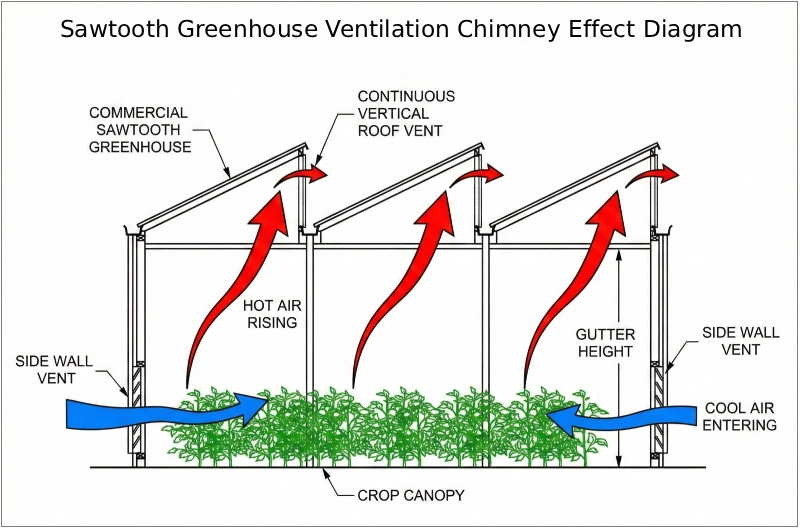
The chimney effect, also known as the stack effect, is the fundamental physical principle that drives natural ventilation in commercial greenhouses. As air inside the greenhouse absorbs heat from solar radiation and plant transpiration, it becomes less dense and naturally rises toward the highest point of the structure. When roof vents are opened, this accumulated hot air escapes, creating a pressure differential that draws cooler outside air into the greenhouse through side vents or lower openings.
How and why this matters in real greenhouse operations:
In large-scale commercial greenhouses, heat accumulation is rarely uniform. The warmest air consistently collects above crop height, along truss lines, and near gutter zones, where it can remain trapped if there is no vertical exhaust path. The chimney effect provides a continuous, energy-free mechanism to remove this trapped heat before it mixes back down into the crop zone. The greater the vertical distance between air intake and exhaust points, the stronger this effect becomes, which is why taller greenhouses with elevated roof vents consistently outperform low-profile structures in natural ventilation efficiency.
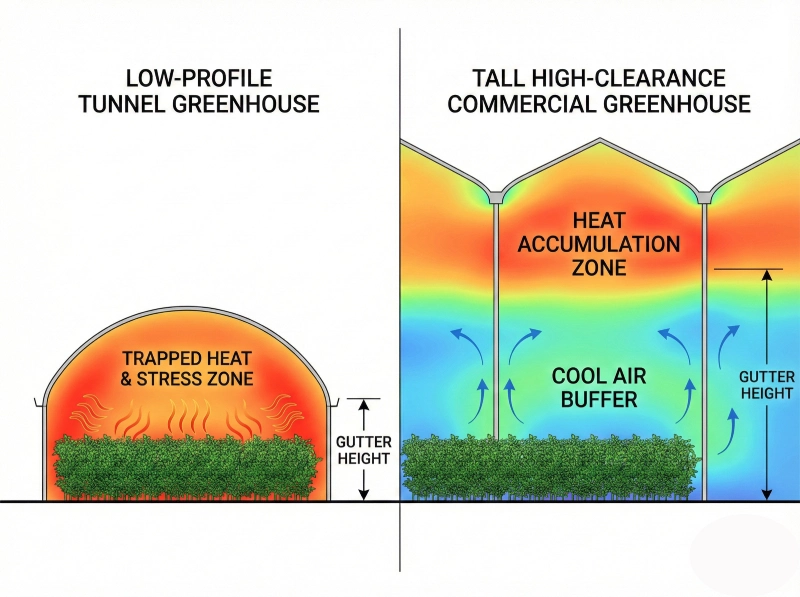
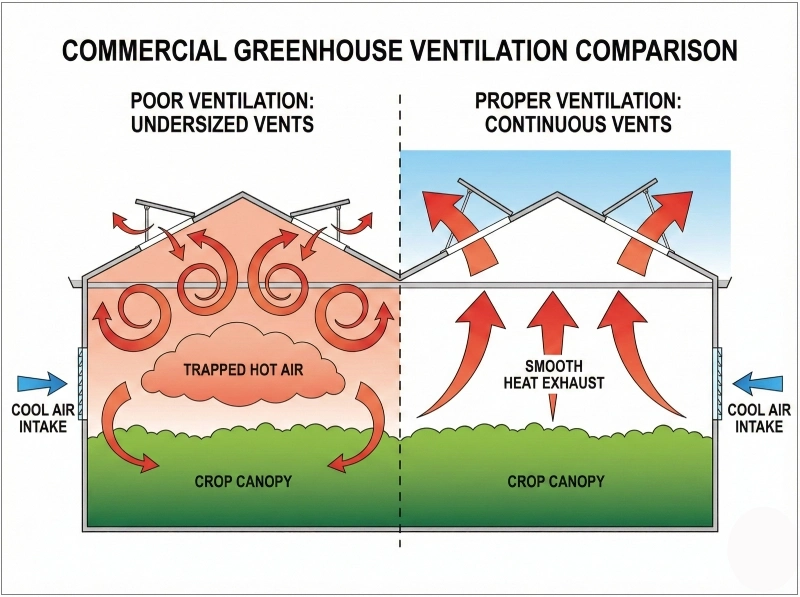
Structural design plays a decisive role in how effectively the chimney effect can operate. Greenhouses with continuous roof vents—such as sawtooth or well-designed Venlo structures—allow hot air to escape evenly across the entire span. In contrast, structures with limited or discontinuous roof openings often experience localized heat pockets and uneven airflow, even when total vent area appears sufficient on paper. In practice, ventilation efficiency depends not only on vent size, but on how consistently hot air can find an unobstructed vertical exit path.
Why this is especially critical for commercial-scale greenhouses:
As greenhouse size increases, air volume grows faster than vent opening capacity if structural height is not scaled accordingly. In multi-span commercial greenhouses, relying solely on horizontal airflow or circulation fans becomes increasingly ineffective. Without a strong chimney effect, hot air recirculates within the structure rather than being expelled, leading to persistent overheating and high humidity near the crop canopy. Natural ventilation driven by vertical buoyancy is therefore not a design preference, but a structural necessity at commercial scale.
It is also important to understand that circulation fans cannot replace the chimney effect. Fans redistribute air within the greenhouse but do not create true air exchange with the outside environment. Without sufficient roof-level exhaust, fans may simply mix hot, humid air back down toward the crops, masking temperature readings while failing to remove heat and moisture from the system. Effective greenhouse ventilation begins with structural exhaust, with mechanical airflow serving only as a supplemental tool.
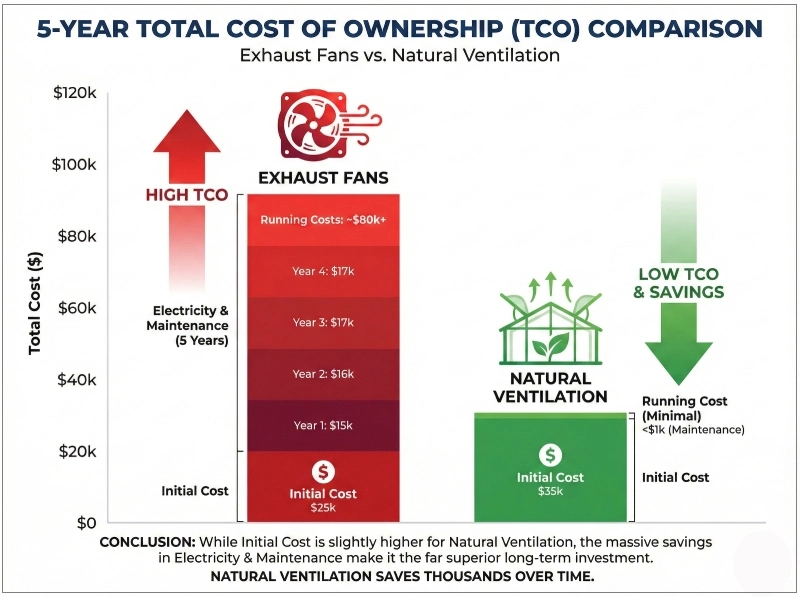
Should you invest in a wall of exhaust fans or a better roof structure? Let’s compare the two dominant strategies for 2026.
1. Mechanical Ventilation (Active)
This system uses electric exhaust fans to force air out, often combined with wet pads (evaporative cooling).
Best for: Crops requiring temperatures below outside ambient levels; regions with low wind.
The Hidden Cost: While effective, the Operational Expenditure (OpEx) is high. Running fans 10-12 hours a day adds significant recurring electricity costs and maintenance requirements (belt replacements, motor failures).
2. Natural Ventilation (Passive)
This system uses roof vents (such as Sawtooth or Butterfly vents) and side roll-ups to allow wind and thermal buoyancy to move air.
Best for: Tropical climates; commercial vegetable production; growers prioritizing ROI.
The Advantage: Zero energy cost. Once built, the wind does the work for free.
Cost Comparison Matrix
Feature | Mechanical Fans | Natural Ventilation (Roof Vents) |
Initial Cost (CapEx) | Low to Medium | Medium (Requires complex structure) |
Running Cost (OpEx) | High (Electricity + Parts) | Zero / Negligible |
Cooling Capability | Can cool below ambient (with pads) | Cools toward ambient temperature |
Maintenance | High (Motors, belts, pads) | Low (Insect nets, gear motors) |
Risk Factor | Power outage = Rapid overheating | Reliable (Passive physics) |
Efficiency is 80% determined by your greenhouse type. Installing fans in a poorly designed structure is like trying to cool a house with the windows closed.
1. The Tropical Champion: Sawtooth Greenhouses
For hot and humid regions (like Malaysia, Indonesia, and Thailand), the Sawtooth Greenhouse is the industry standard for natural ventilation.
Its vertical roof vent creates a permanent opening at the highest point, maximizing the chimney effect without letting rain in.
Learn more about Sawtooth specifications in our Complete Guide to Commercial Greenhouse Types.
2. The High-Tech Standard: Venlo Greenhouses
Common in temperate climates, Venlo structures use alternating roof vents. They offer excellent sealing for winter heating but can open up for summer ventilation.
See why Venlo is preferred for high-tech farms in our Greenhouse Types Guide.
3. The Budget Option: Tunnels with Roll-ups
For basic tunnel greenhouses, installing side roll-up units is the minimum requirement. However, without roof ventilation, heat will still accumulate at the peak.
In Southeast Asia, the challenge isn't just heat—it's humidity.
Many growers make the mistake of using circulation fans in a closed greenhouse. Warning: Fans do not remove humidity; they only move moist air around.
To lower humidity (and prevent fungal diseases), you must physically remove the moisture-laden air. Since humid air is less dense than dry air, it rises. Therefore, vertical roof vents (like those on Sawtooth structures) are significantly more effective at dehumidification than side windows alone.
Pro Tip on Insect Nets:
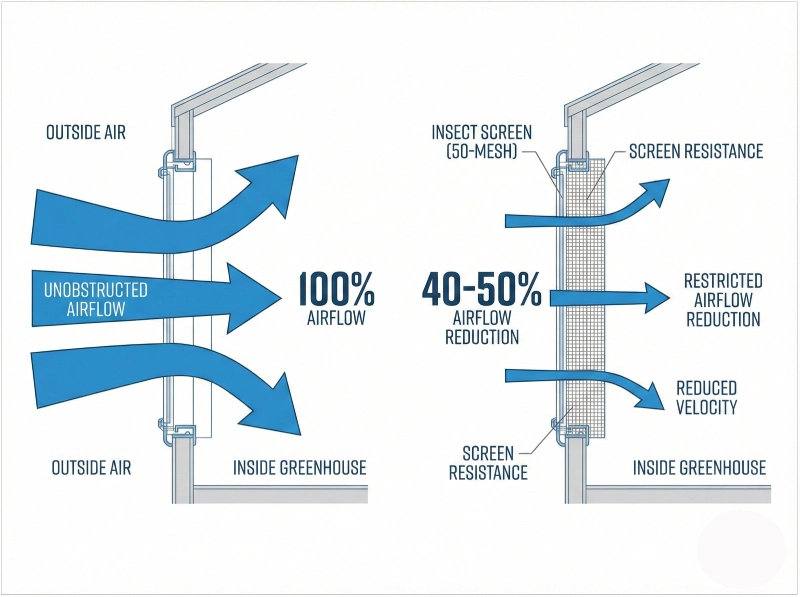
In tropical regions, insect nets are mandatory. However, a high-density net (e.g., 50-mesh) can reduce airflow by 40-50%.
Recommendation: Ensure your ventilation surface area is large enough to compensate for the resistance created by insect nets. A High-Clearance design (higher gutter height) also creates a larger air buffer to stabilize the climate.
Even when ventilation is considered during the design phase, many commercial greenhouses still underperform due to avoidable structural and planning errors. These mistakes often stem from focusing on equipment specifications rather than airflow fundamentals. Once a greenhouse is built, correcting ventilation deficiencies becomes costly and operationally disruptive, making early design decisions especially critical.
1. Undersized Roof Vent Area
One of the most common mistakes is insufficient roof vent area relative to greenhouse floor space. Designers may technically include roof vents but allocate too little opening area to enable effective heat exhaust.
Why this causes long-term problems:
When roof vents are undersized, hot air cannot escape at the same rate it is generated. This leads to heat accumulation near the roof, forcing growers to rely on mechanical cooling systems that were never intended to compensate for structural limitations. In practice, even powerful fans cannot overcome restricted exhaust capacity, resulting in persistent overheating during peak solar hours.
2. Poor Vent Placement and Discontinuous Openings
Vent effectiveness depends not only on total opening area, but also on how vents are distributed across the structure. Concentrating vents in isolated sections of the roof or using intermittent openings disrupts natural airflow patterns.
Why this reduces ventilation efficiency:
Hot air rises uniformly across the greenhouse span, not in isolated zones. When exhaust points are discontinuous, warm air becomes trapped between structural bays, creating localized heat pockets. This leads to uneven growing conditions and forces circulation fans to work harder, often without resolving the underlying airflow imbalance.
3. Overreliance on Circulation Fans Instead of Exhaust Paths
Circulation fans are frequently mistaken for ventilation solutions. While they improve internal air movement, they do not provide meaningful air exchange with the outside environment.
Why this mistake is difficult to detect:
Temperature sensors may show temporary improvements as hot air is mixed downward, giving the impression of effective cooling. However, humidity and heat remain within the system. Without proper exhaust at roof level, fans simply redistribute energy rather than removing it, masking ventilation deficiencies until crop stress or disease pressure becomes evident.
4. Ignoring Crop Height and Canopy Density
Ventilation design is often finalized before crop selection and planting density are fully considered. As crops mature, canopy height and density significantly alter airflow dynamics.
Why this matters in commercial operations:
Dense canopies restrict horizontal air movement and trap humid air near the plant surface. If ventilation capacity is not designed with mature crop conditions in mind, air exchange becomes progressively less effective over the growing cycle. This is especially problematic for high-wire crops such as tomatoes, cucumbers, and peppers.
5. Neglecting Insect Screens and Netting Resistance
In warm and tropical regions, insect screens are essential—but their impact on airflow is frequently underestimated.
Why this becomes a hidden bottleneck:
Fine mesh screens can reduce effective airflow by 40–50% or more, depending on mesh density and cleanliness. When ventilation systems are designed without accounting for this resistance, real-world performance falls far short of theoretical calculations. Over time, dust and organic buildup further degrade airflow, compounding the problem.
6. Lack of Automation and Responsive Control
Manual vent operation or basic on/off control systems are still common in commercial greenhouses, particularly in emerging markets.
Why manual control limits performance:
Ventilation demand changes rapidly with solar radiation, wind, and crop transpiration rates. Manual systems cannot respond quickly enough to prevent temperature and humidity swings. Automated vent control, even at a basic level, allows the greenhouse to maintain more stable conditions while reducing labor and operator error.
Q1: How do you calculate the required ventilation rate?
For commercial greenhouses, the goal is typically 0.75 to 1 air exchange per minute to maintain temperatures near ambient levels. This volume determines the size of your fans or the surface area of your roof vents.
Q2: Can I automate natural ventilation?
Yes. Natural ventilation does not mean "manual." Sawtooth and Venlo roof vents are operated by motorized rack-and-pinion systems connected to a climate computer. The system automatically opens vents when the temperature rises or closes them if it rains.
Q3: Does a greenhouse need ventilation at night?
Yes. Plants respire at night, releasing moisture. A small amount of ventilation is often required to prevent humidity from reaching 100% (saturation), which causes condensation and disease.
Conclusion: Structure First, Equipment Second
Good ventilation starts on the drawing board, not in the hardware store. While exhaust fans have their place, relying on them as a primary cooling strategy in tropical climates is often a financial burden.
By selecting an aerodynamically efficient structure like the Sawtooth, you harness the power of physics to cool your crops—protecting both your plants and your bottom line.
Is your current greenhouse overheating? Or are you planning a new project in a tropical climate?
Contact our engineering team today to simulate the natural airflow for your site design.
 English
 Malaysia
 Indonesia